Explainer Videos, Crafted by Humans and Machines: The Making of Dewi
,In September and October 2026, we ran a series of short, to-the-point explainer videos featuring our cartoon robot colleague Dewi. The format successfully combined elements of both human- and AI-driven tech journalism. Here's how everything came to pass – and what we've learned from producing "Dewi explains".
If you've been following our social media game, you've probably noticed that it's usually heavy on text and static images. The reason for that is simple: Creating appealing audio-video (AV) content is still relatively complex and expensive. And since we're an R&D team (not a newsroom), our resources for producing journalistic pieces are limited.
However, the advent of more sophisticated generative AI tools, a growing library of DW Lab prototypes and the improved collaboration across departments presented us with a unique chance: Producing quality web videos on a shoestring (in the end, we actually spent a little more time and money than we thought, but we'll get to that later).
Without further ado, these are the four steps we took to get to a finished, more or less polished collection of Dewi videos.
From wonky prototypes to polished web videos
We began by dusting off an Avatario prototype from an old DW Lab experiment, more specifically the one based on Blender and XCode. We reactivated the project on Testflight, fixed a couple of minor bugs, slightly improved the UX/UI, and switched the default language to English. The result was a manually crafted iOS app that – with a little trick – would also run on our laptops. Here, it would spew out videos that had a (somewhat) likeable, but also wonky robot character with a generic synthetic voice read random, lorem ipsum stuff to us. So far, so good. Now, we had to come up with meaningful content.
In a second step, we (manually) researched and subsequently discussed media/tech topics the little 3D robot could later on dissect for our audience. Once we had that list, it was time to come up with the first scripts. As we wanted to save time, we used an LLM (in this case: Claude Sonnet 5) as a co-creator. To be more precise: We set up a project, wrote a detailed prompt (role, tonality, format instructions...), and provided topic-specific notes and comments as well as hyperlinks with background info. The result were a couple of decent, but imperfect scripts we went on to edit and polish manually. After two or three iterations, the results were just fine – and we could finally focus on the video production itself.
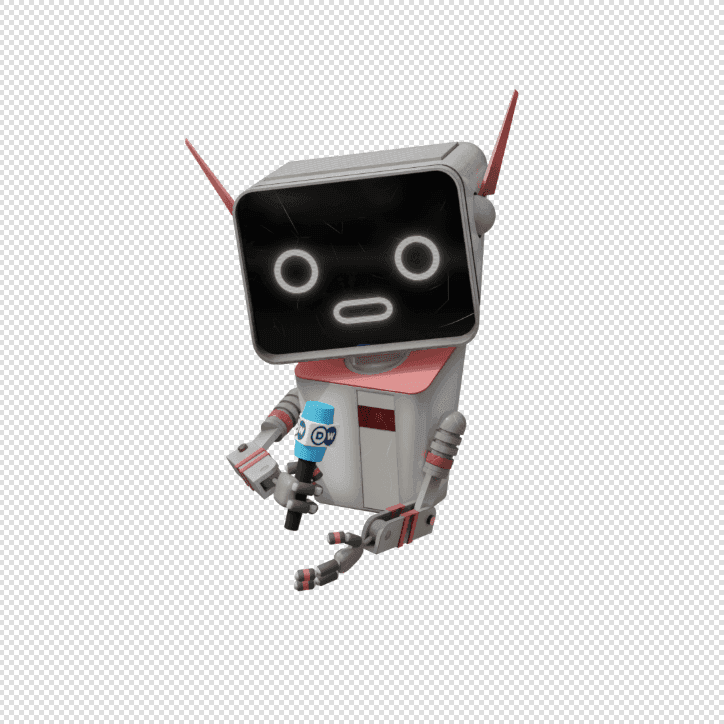
At this point, things got a bit more complicated. First of all, we realized that the wonky robot character was indeed: wonky. There still were a few glitches, the set of animations was pretty limited, and we also weren't too fond of the color scheme. The easy solution in this case was to ping our colleague Lars Jandel, a 3D animation expert, and ask him to brush up everything. He got to work right away and gave us the version of Dewi you're looking at today. A combination of scripts in our app eventually took care of joining the new animation sequences in a smoother way.
Now we had to find a good synthetic voice service, one we could tap into via our app and its API. After a couple of test runs, we picked a young, confident female AI narrator offered by ElevenLabs, then added emphasis in some places.
Just when we thought we were set, we discovered another challenge: Dewi discussing tech and media topics for 90+ seconds on a simple green (or black) screen was just: boring. We really had to spruce up the videos and work on the visuals. Long story short: GenAI didn't help (we tried a bunch of tools), so we eventually resorted to creating proper storyboards, looking for appealing visuals (Creative Commons, Open Verse, Pexels, Pixabay, Rawpixel, Unsplash) – and editing our videos in Adobe Premiere. It was worth it: We were now looking at a product that felt more techy and modern, but also a little old school, revealing a human touch. Exactly what we had aimed for.
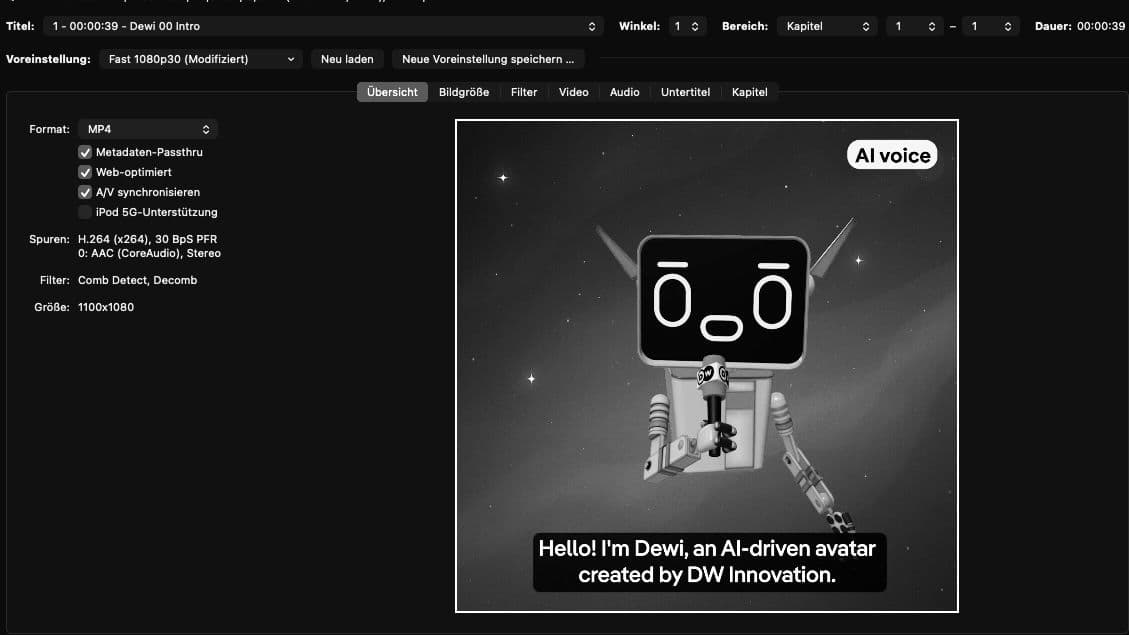
Once we had produced a first, short season of Dewi videos – six regular clips and one intro – it was time for finishing touches, logistics, and documentation: We put in hard-coded, visually appealing subtitles, labelled the use of AI in the clips (in accordance with DW guidelines), and made sure we had only used visuals from copyleft/creative commons sources or images created by our team, and hit the export button in Premiere. We also transcoded all videos via HandBrake to make sure they'd be lightweight, i.e. easy to share and upload.
In terms of publishing platforms, we decided to go a somewhat unconventional way: "Dewi explains" was uploaded to our Fediverse/Mastodon presence (to support a fully open, sustainable network) and to our LinkedIn page to cater to the majority of our media and business contacts.
Responsible Synthetic Journalism
"Dewi explains" was conceived and produced in line with a concept we like to call responsible synthetic journalism (RSJ). The guiding principles look something like this:
-
We enlist AI tools to create something special we wouldn't be able to publish otherwise – due to lack of time and resources; we make use of cutting-edge technology "to go that extra mile" (in this case: create AV content, not just a regular post).
-
"Keeping humans in the loop" is more than an empty phrase to us. We take full control of the creative and editorial process; we're not interested in replacing the expertise of media professionals or becoming a slop factory.
-
We use LLMs in a sustainable fashion: There's no need to go through dozens of iterations when you can thoroughly prepare your source material – and then hit that GenAI button only once or twice.
Future plans
It's currently unclear if we'll have the time and resources to do a second season. In case we do, here's a couple of things we'd love to try:
-
adjust/tweak the voice, especially with regard to better flow and intonation
-
improve the scripts running the Dewi animations (and maybe add another set)
-
equip the Dewi/Avatario app with a semi-automated subtitling function (currently subtitling is done in Adobe Premiere)
-
give the app basic video editing features, ideally in combination with a feature that automatically retrieves or synthesizes fitting images and animations (which is quite a challenge)
Feedback appreciated
Do you have any comments or questions? Would you like to collaborate in any way? Feel free to get in touch via innovation@dw.com
We're looking forward to your feedback on "Dewi Explains".
List of Episodes (incl. Fediverse links):