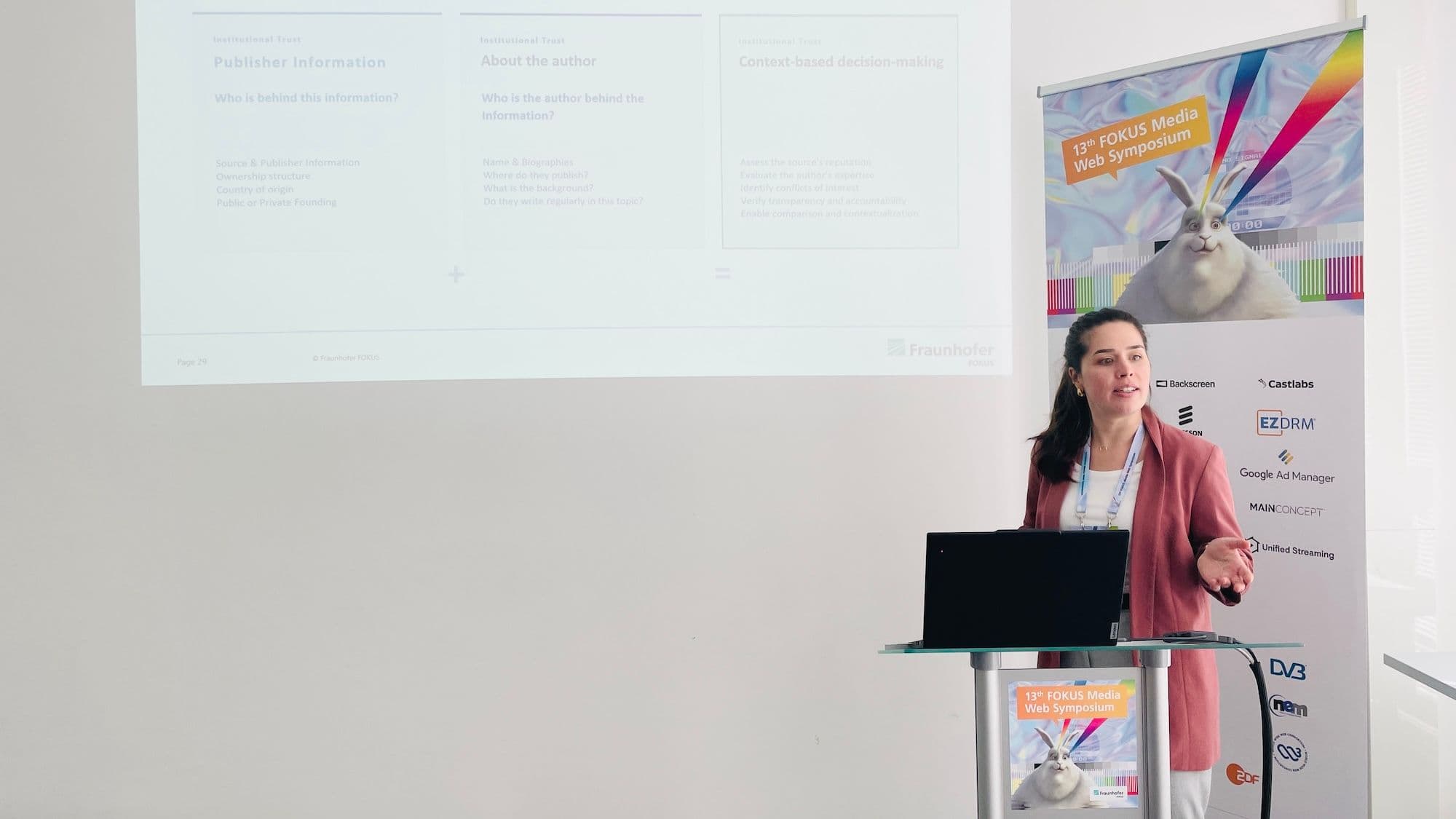
Trust and Transparency by Design: Naomi Schoppa on CleanFeed
,The web is brimful of manipulated content, disinformation, and AI slop these days. We're all aware of that. Those in the business of fact-checking and verification also know that it's becoming impossible to detect, document, and debunk all the digital trash out there. For this reason, some media projects have shifted their focus. Assuming that a massively cluttered internet is the new normal, they're trying to put the car before the horse, i.e.: label the content produced by their organizations as legit and trustworthy. It's all about showing where news, images, and videos come from, who has handled or edited them – and how origins and editing histories can be verified. One of the R&D efforts tackling the issue is CleanFeed – co-launched by DW Innovation earlier this year.
To give you a couple of insights on the issues of provenance, transparency, and new ways to establish digital trust, I've had a conversation with Naomi Schoppa, Research Associate at Fraunhofer FOKUS and one of the lead coordinators of the project.
Alexander Plaum (AP): Hi Naomi. In your keynote at this year's MWS, you said that we shouldn't simply label manipulated or AI-generated content, but "establish a new framework of trust". Can you elaborate on this?
Naomi Schoppa (NS): Labelling is an important first step, as it creates a basic level of transparency for end-users. However, transparency through labels alone is not enough. These days, information is disseminated across many different systems and platforms, from media libraries and news websites to social networks. Labelling that exists only within a single platform can easily be lost, removed or become disconnected from the actual content. So what we need is a comprehensive trust framework that enables information about a piece of content – such as its origin, provenance and any modifications – to travel with it across system boundaries. To achieve this, we need multiple levels of protection, along with technical feasibility. We need a framework that ensures trust, transparency, and interoperability through common standards and a unified language. It's not just about showing users a label at the time of use. It's about offering a way to verify trust-related information throughout the entire lifecycle of the content, regardless of where the content is published, shared or viewed.
AP: How exactly is CleanFeed different from "traditional" verification projects?
NS: Many projects focus on fact checking, i.e. they assess if statements are true or false or misleading. This is not what we do. Likewise, we don't focus on media forensics: We don't perform technical analyses of media content to determine if pixels or other elements of an asset have been manipulated. What we do focus on is metadata and cryptographic methods to secure and validate the content itself. This enables us to assess where a piece of content originates, who created it, and what happened to it between its creation and publication. In other words, we try to answer key questions about provenance, authorship, and content history. It's important to stress that this doesn't tell us if the content itself is factually correct. Media assets can be authentic and verifiably linked to a source and misleading and inaccurate at the same time.
AP: Regarding the technical layer, there are basically three ways to check and prove the identity of a digital asset, right? C2PA is mostly about meta data; it documents provenance as well as edit histories. ISCC is about deriving a specific code from the file itself; you end up with content-based identifiers. Finally, water mark services (like the one offered by our partners at CL) try to "hide" identity in the pixels; this goes back to the concept of steganography. What approach is the most promising? Can we implement all of them at the same time?
NS: First of all, I would challenge the assumption that there are only three approaches – there are actually many more out there, operating at different levels and serving different purposes. As for the approaches you mentioned: C2PA is a standard, and so is ISCC. Watermarking is more of a technical mechanism. And yes, we end up with more powerful tools when we combine those solutions. C2PA can provide verifiable provenance information, ISCC can help identify and correlate content across platforms, and watermarking creates an additional link between the content and its trust information, even under challenging distribution conditions. To put it differently: Authenticity and integrity are not achieved through a single technology. They require a combination of standards and technical safeguards.
AP: As a person with a background in the humanities, I'm quite happy that CleanFeed also has a media/information literacy layer. For example, our team aims to build news feeds that not only indicate provenance, but also journalistic perspectives, media ownership, and potential bias. What do you think about this approach?
NS: I think the collaboration between technologists and journalists is essential. From a technical perspective, we can develop ideas and prototypes, assess feasibility, and build pilot solutions based on these findings. These pilots can then be reviewed by our project partners from the journalism domain and evaluated from their perspective, e.g. with regard to ideological influences – or simply relevance for editorial workflows. By continuously exchanging knowledge, testing solutions together, and feeding the results back into the development process, we can effectively combine technical and journalistic approaches. The collaboration between both disciplines is crucial to the success of the project.
AP: In general, what are the main challenges of the CleanFeed project? And how can we tackle them?
NS: I guess we face two main challenges: one is technical, one is user-centered. As for the technical challenge, integrating trust and provenance information into media workflows is certainly feasible. However, it mustn't degrade quality or add friction to existing processes. We also need to determine if and to which extent we can achieve EU sovereignty. Regarding the UX/UI challenge, our target group ranges from media professionals to everyday consumers, and they all have different information needs and levels of understanding. So we must find the right way to present provenance information to each of them. In any case, we'll test our assumptions through pilot deployments and user studies, and use the results to refine our solutions. Our interdisciplinary consortium is a key strength here. By combining expertise in technology, media, research, and user experience, we can develop solutions that are technically robust and centered on users.
AP: The next question is tough, and neither of us is a legal expert. However, I'd like to quickly touch on this issue as well: Calls with international partners recently made it very clear that European players who'd like to adopt C2PA – arguably the most influential emerging standard – are facing political challenges. It seems that in order to comply with C2PA's conformance programs, you have to accept US rules and jurisdiction; ultimately, you're at the mercy of the American Bureau of Industry and Security (BSI) – that has to approve of your organization. It certainly isn't alarmist to point out that there might be a conflict between the US government and, let's say, the BBC at some point. Furthermore, it seems unlikely that the EU will accept a standard/certificate that only has a legal anchor in the US. Is there a way to fix this?
NS: Well, I'm a technologist, and I can't really make an assessment here. In general, I'd say that EU sovereignty is becoming increasingly important. And that it must be taken into account when working on the C2PA standard.
AP: Ok. Let's take a look into the near future. What would be a good outcome of CleanFeed? And where do you see the digital infosphere at the end of the decade?
NS: One of the key challenges of the coming years will be dealing with low quality synthetic content. Several studies and articles (e.g. this one or this one or this one) suggest that it'll make up a big chunk of the information we encounter online. We're also moving towards a future in which humans and AI systems will interact more closely than ever before. In such a scenario, transparency becomes essential. Users need to understand where content comes from, whether it was AI-generated or modified, and how trustworthy it is. Initiatives such as the EU AI Act have introduced transparency obligations for certain types of content. Projects like CleanFeed can help address these requirements by combining technical standards, trust technologies, and user-centric transparency approaches. A great outcome for CleanFeed would be to demonstrate that trustworthy provenance information can be preserved and communicated across the entire media ecosystem, from content creation to consumption. Looking towards the end of the decade, I expect trust and transparency information to become a normal part of our digital infrastructure, much like security certificates are today. It'll be an exciting period of innovation, but also one that requires significant collaboration and effort across technology, media, policy, and society.
AP: Anything else you'd like to add?
NS: These are exciting times, we have plenty of research ahead of us – and I'm looking forward to continuing our collaboration. Thank you.
AP: Dear Naomi, thanks for the exchange. And let's keep up the good team work!
This interview has been edited for length and clarity.